
When darkness falls, seeing clearly becomes a challenge. Whether you are exploring the outdoors, observing wildlife, conducting security patrols, or navigating unfamiliar environments, having the right night vision technology can make a significant difference.
But not all night vision devices work in the same way.
Traditional infrared night vision, full-color low-light night vision, and thermal imaging each use different technologies to help users see in dark environments. Understanding these differences can help you choose the right device for your needs.
In this guide, we explore how these technologies work, their advantages and limitations, and why full-color night vision is becoming an increasingly interesting option for outdoor observation.
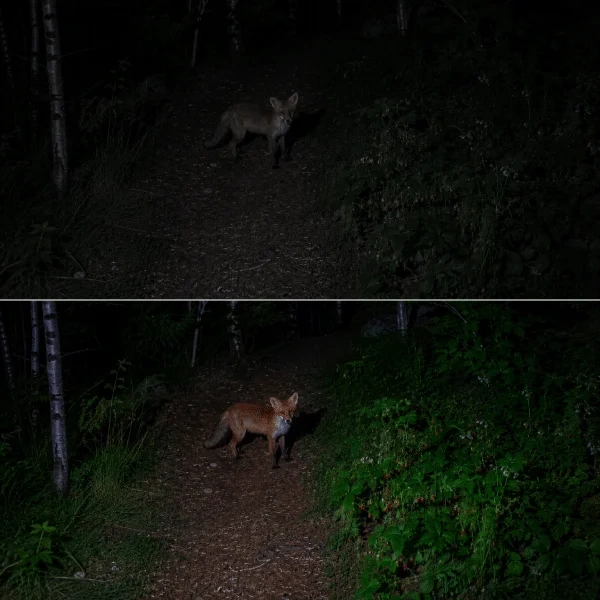
1. How Does Traditional Infrared Night Vision Work?
Traditional infrared (IR) night vision uses near-infrared light to illuminate a scene that is too dark for normal human vision.
Most digital infrared night vision devices use built-in infrared LED illuminators, commonly operating at 850nm or 940nm.
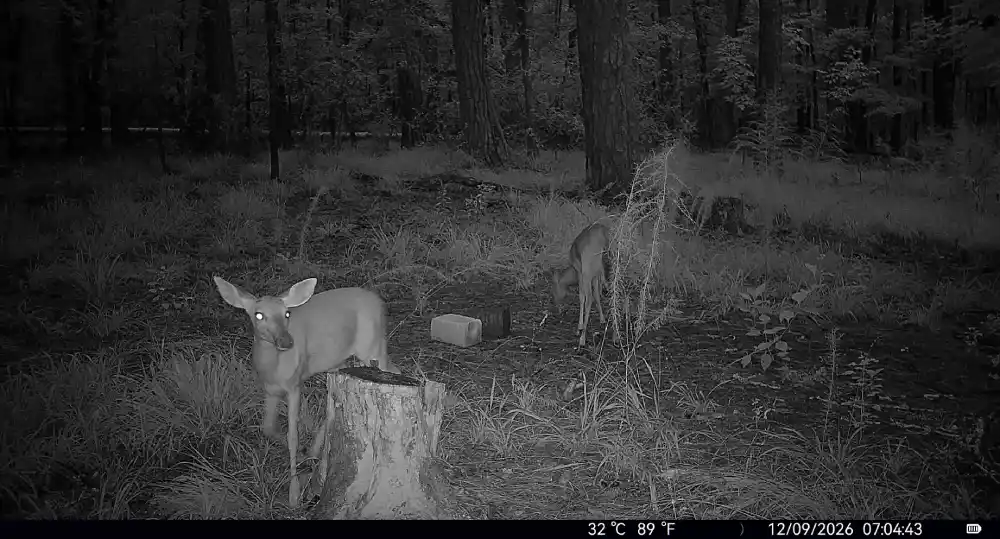
The device emits infrared light toward the surrounding environment. Although this light is largely invisible to the human eye, the camera sensor can detect the reflected infrared radiation and convert it into a visible image.
The result is typically a black-and-white night vision image.
Advantages of infrared night vision:
- Works in extremely dark environments when equipped with an appropriate IR illuminator.
- Provides clear outlines of objects, animals, and surrounding structures.
- Does not depend entirely on natural ambient light.
- Suitable for nighttime surveillance, wildlife observation, and security applications.
Limitations:
- Images are generally displayed in black and white.
- Color information is unavailable, making some details harder to distinguish.
- Performance depends on the IR illuminator’s power, wavelength, and coverage.
- Infrared illumination may be detectable by other night vision equipment, and some 850nm illuminators produce a faint red glow.
Traditional IR night vision remains a practical solution, especially when observing in environments with little or no ambient light.
2. What Is Full-Color Night Vision?
Full-color night vision takes a different approach.
Instead of relying primarily on infrared illumination, low-light full-color imaging technology captures and processes the small amounts of visible light available in the environment.
This light may come from moonlight, starlight, distant streetlights, or other weak ambient sources.
A highly sensitive imaging system, combined with image processing, helps produce color images even under extremely low-light conditions.
Unlike conventional infrared night vision, which typically produces monochrome images, full-color night vision preserves color information.
This can make it easier to recognize objects, distinguish natural surroundings, and observe details.
Key advantages of full-color night vision:
- Preserves natural color information in low-light environments.
- Provides a more familiar viewing experience.
- Helps distinguish objects with similar shapes but different colors.
- Offers useful visual details for outdoor exploration and observation.
However, there is an important distinction: full-color low-light night vision still needs some available light. In complete darkness, a conventional low-light color imaging system cannot create a normal color image without additional illumination.
For this reason, understanding the device’s actual low-light sensitivity is important when comparing different products.
3. Infrared vs. Full-Color Night Vision: Key Differences
Both technologies help users see in the dark, but they serve slightly different purposes.
| Feature | Infrared Night Vision | Full-Color Night Vision |
|---|---|---|
| Imaging method | Active infrared illumination | Sensitive low-light imaging |
| Typical image | Black and white | Full color |
| Ambient light requirement | Can work in total darkness with IR illumination | Requires some ambient light |
| Color information | Generally unavailable | Preserved |
| Main advantage | Nighttime visibility in very dark conditions | More natural and detailed color observation |
| Typical applications | Surveillance, wildlife observation, security | Outdoor exploration, observation, security |
Neither technology is universally better.
The right choice depends on the lighting conditions, intended application, and the type of visual information you need.
For users who value natural color details in extremely dim environments, full-color low-light night vision offers an attractive alternative.
4. What About Thermal Imaging? Is It the Same as Infrared Night Vision?
This is another common question.
Although both infrared night vision and thermal imaging involve infrared technology, they work in fundamentally different ways.
Infrared night vision detects reflected near-infrared light, usually supplied by an external or built-in IR illuminator.
Thermal imaging detects infrared radiation emitted by objects based on their temperature.
Thermal devices do not need visible light or an IR illuminator to create an image. Instead, they display temperature differences between objects and their surroundings.
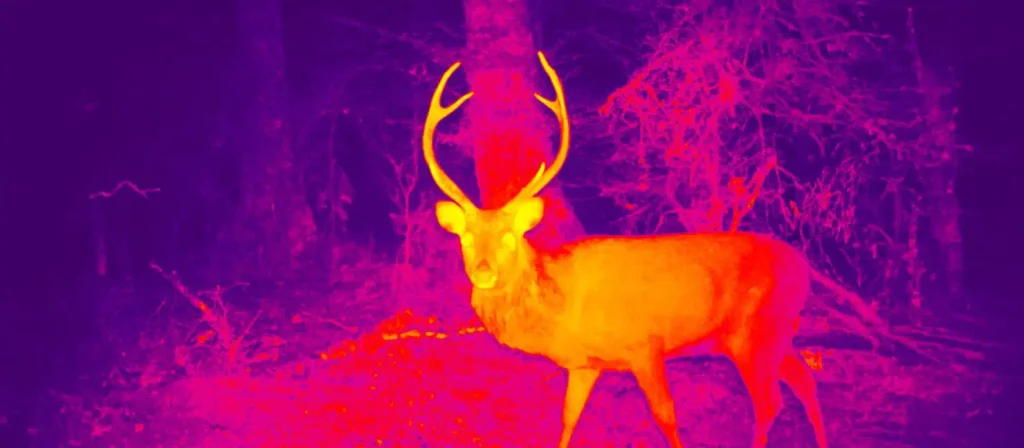
For example, a thermal imaging device may help locate an animal in a dark field because its body temperature differs from the surrounding environment.
However, thermal imaging usually does not provide the natural colors and familiar visual details of a conventional optical image.
Here is a simple comparison:
- Infrared night vision: Helps you see objects using infrared illumination.
- Full-color night vision: Helps you see natural colors using available ambient light.
- Thermal imaging: Helps you detect objects through their heat signatures.
These technologies complement each other rather than directly replacing one another.
5. Introducing the NV1300 Full Color Night Vision Monocular
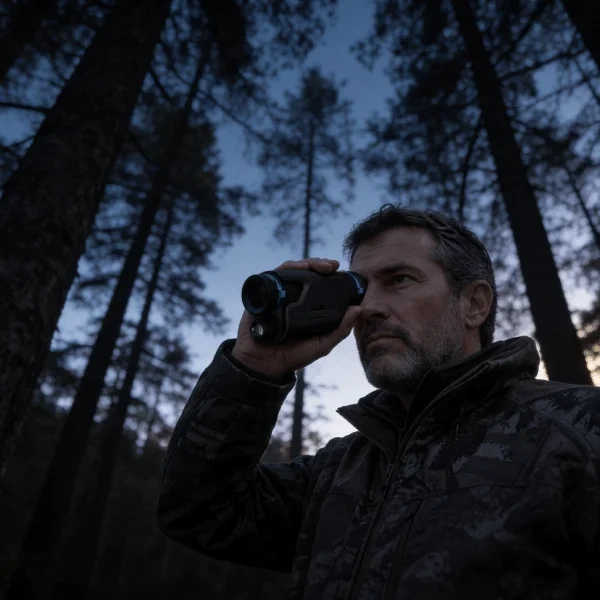
For users looking for a compact digital night vision device with color imaging capabilities, GreatView Tech introduces the NV1300 Full Color Night Vision Monocular.
Designed for outdoor exploration, nighttime observation, security patrols, and other outdoor applications, the NV1300 combines low-light imaging performance with practical digital functions.
Its full-color imaging capability is designed to capture clear color images in low-light conditions, with a rated low-light sensitivity of 0.001 lux.
Key Features of the NV1300
Full-Color Night Vision
Designed for color imaging in extremely low-light environments, helping users observe more natural visual details instead of relying exclusively on traditional black-and-white infrared images.
25mm Precision Optics
A 25mm optical system provides a practical viewing experience for outdoor observation.
8X Digital Zoom
Digital magnification allows users to examine distant objects more closely.
1.43-Inch OLED Display
The high-quality OLED display features a 466 × 466 resolution, providing a vivid and power-efficient viewing experience.
4K Video Recording
Supports 4K video recording at 30fps or Full HD 1080P video recording, allowing users to capture nighttime observations.
Programmable Image Resolution
Users can select from 2MP, 5MP, 8MP, and 12MP photo resolutions according to their needs.
Replaceable 18650 Battery
Powered by one replaceable 18650 rechargeable battery (not included), offering convenient battery replacement for extended outdoor use.
IP66 Protection
The IP66-rated housing provides protection against dust and water exposure, making the device suitable for demanding outdoor environments.
Optional AI Recognition
An optional AI recognition function can identify people, animals, and vehicles, adding intelligent recognition capabilities.
NV1300 Technical Specifications
| Specification | Details |
|---|---|
| Model | NV1300 |
| Night Vision Type | Full-Color Digital Night Vision |
| Low-Light Sensitivity | 0.001 Lux |
| Optical Lens | 25mm |
| Digital Zoom | 8X |
| Display | 1.43-inch OLED |
| Display Resolution | 466 × 466 |
| Video Recording | 4K @ 30fps / 1080P |
| Photo Resolution | 2MP / 5MP / 8MP / 12MP |
| Battery | 1 × Replaceable 18650 |
| Waterproof Rating | IP66 |
| AI Recognition | Optional |
| Battery Life | Approximately 4 hours, depending on usage |
| Dimensions | 170 × 86 × 50mm |
| Weight | 394g |
The NV1300 is designed to offer a balance of portability, imaging performance, and practical functionality in one compact monocular.
6. Where Can Full-Color Night Vision Be Used?
Full-color night vision can be useful in a variety of outdoor situations where identifying visual details matters.
Outdoor Exploration
Observe trails, landscapes, and surrounding environments in low-light conditions while retaining color information.
Wildlife Observation
Identify animals and observe their surroundings with more natural-looking images when sufficient ambient light is available.
Security Patrols
Help security personnel observe outdoor areas and recognize visual details during nighttime patrols.
Search and Rescue
Support nighttime visual observation in outdoor environments where available ambient light allows color imaging.
Camping and Outdoor Activities
Provide additional visibility when exploring campsites, trails, and unfamiliar surroundings after sunset.
The actual viewing performance will depend on ambient light, environmental conditions, and the distance to the subject.
7. How to Choose the Right Night Vision Technology
Before purchasing a night vision device, consider the following questions:
Do you need to see in complete darkness?
If there is absolutely no ambient light, an IR-equipped night vision device or thermal imaging device may be more suitable.
Do you want natural color images?
If recognizing colors and observing more natural visual details are important, a full-color low-light night vision monocular is worth considering.
Do you need to detect heat signatures?
If your primary objective is locating warm objects or animals rather than viewing natural-color images, thermal imaging may be the better choice.
Do you need a portable device?
For handheld outdoor observation, consider the device’s dimensions, weight, battery design, display, and durability.
The best night vision technology is the one that matches your actual environment and application.
Conclusion: A New Approach to Nighttime Observation
Night vision technology continues to evolve, offering users more choices than traditional infrared imaging alone.
Infrared night vision remains valuable for operation in complete darkness, while thermal imaging provides a different way to detect objects through temperature differences.
Full-color low-light night vision offers another advantage: the ability to preserve natural color information in extremely dim environments.
The GreatView NV1300 Full Color Night Vision Monocular brings together 0.001 lux low-light imaging, 4K video recording, 8X digital zoom, an OLED display, and a compact handheld design.
For outdoor enthusiasts, security applications, and professional equipment distributors looking for a modern digital night vision solution, the NV1300 is worth exploring.
Interested in the NV1300 or looking for an OEM/ODM night vision manufacturing partner?
Contact GreatView Tech to learn more about product specifications, customization options, and private-label manufacturing opportunities.